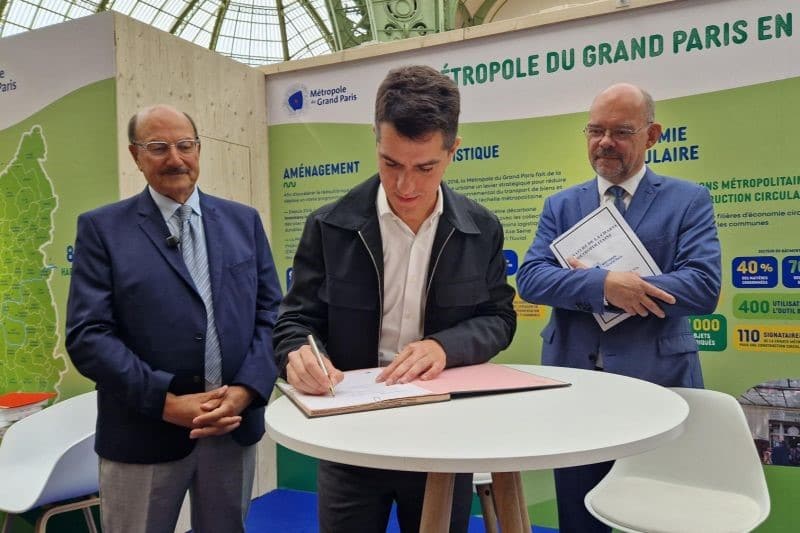
Circular construction is a collective endeavor. It is with this conviction that Sofiane Chikh, Director of Development and Planning at ECT, signed the Metropolitan Charter for Circular Construction, spearheaded by the Greater Paris Metropolis.
A signing ceremony at SIBCA, attended by metropolitan elected officials
The signing ceremony took place at SIBCA, the Low-Carbon Real Estate Trade Show. Entirely dedicated to this topic, the trade show aims to place low-carbon strategies at the heart of real estate development.
Two elected officials from the Greater Paris Metropolis attended the signing ceremony. Xavier Lemoine, mayor of Montfermeil, represented the circular, collaborative, social, and solidarity-based economy, for which he serves as the designated metropolitan councilor. At his side was Jacques-Alain Bénisti, mayor of Villiers-sur-Marne, who serves as vice president in charge of monitoring the “Let’s Build the Greater Paris Metropolis” initiative.
Greater Paris: A Region with Extraordinary Needs
With 130 municipalities and 7.5 million residents, the Greater Paris Metropolitan Area is facing an extraordinary rate of urban growth. The need for housing and infrastructure there is immense.
To meet these needs in a sustainable manner, the region’s development model must change. It now centers on sustainable construction, the reuse of materials, the repurposing of excavated soil, and the rehabilitation and transformation of brownfields.
This metropolitan dynamic is based on three pillars:
- the “Let’s Invent the Greater Paris Metropolis” program, with 23 projects already completed;
- the Circular Construction Club, which brings together expertise and projects;
- technical support (engineering, resources, publications) organized by Ekopolis.
A charter to make circular construction a collective commitment
By signing this charter, ECT joins a group of 120 signatories united around 30 concrete commitments. Its strength lies in its pragmatic approach: it genuinely takes into account the constraints of various industries and has an impact across the entire value chain.
Excavated soil: at the heart of ECT's commitment
This commitment is a natural extension of ECT’s business. Our model is based on the circular economy of excavated soil from the construction and public works sector. Specifically, inert soil from local construction sites is repurposed to transform abandoned land into agricultural, natural, sports, or recreational spaces.
The reuse of excavated soil and the transformation of brownfield sites are among the key drivers of circular urban construction. By signing this agreement, ECT aims to contribute, alongside stakeholders in the Greater Paris region, to this collective effort.