

On October 7, nearly 50 people gathered in Mazingarbe to inaugurate the forest area, the seed orchard, and the greenway developed at the foot of slag heap 49. At the heart of the project is a seed orchard with 1,250 trees, surrounded by a forest and farmland. This transformation was made possible by the circular economy of construction and public works land.
An inauguration attended by local stakeholders
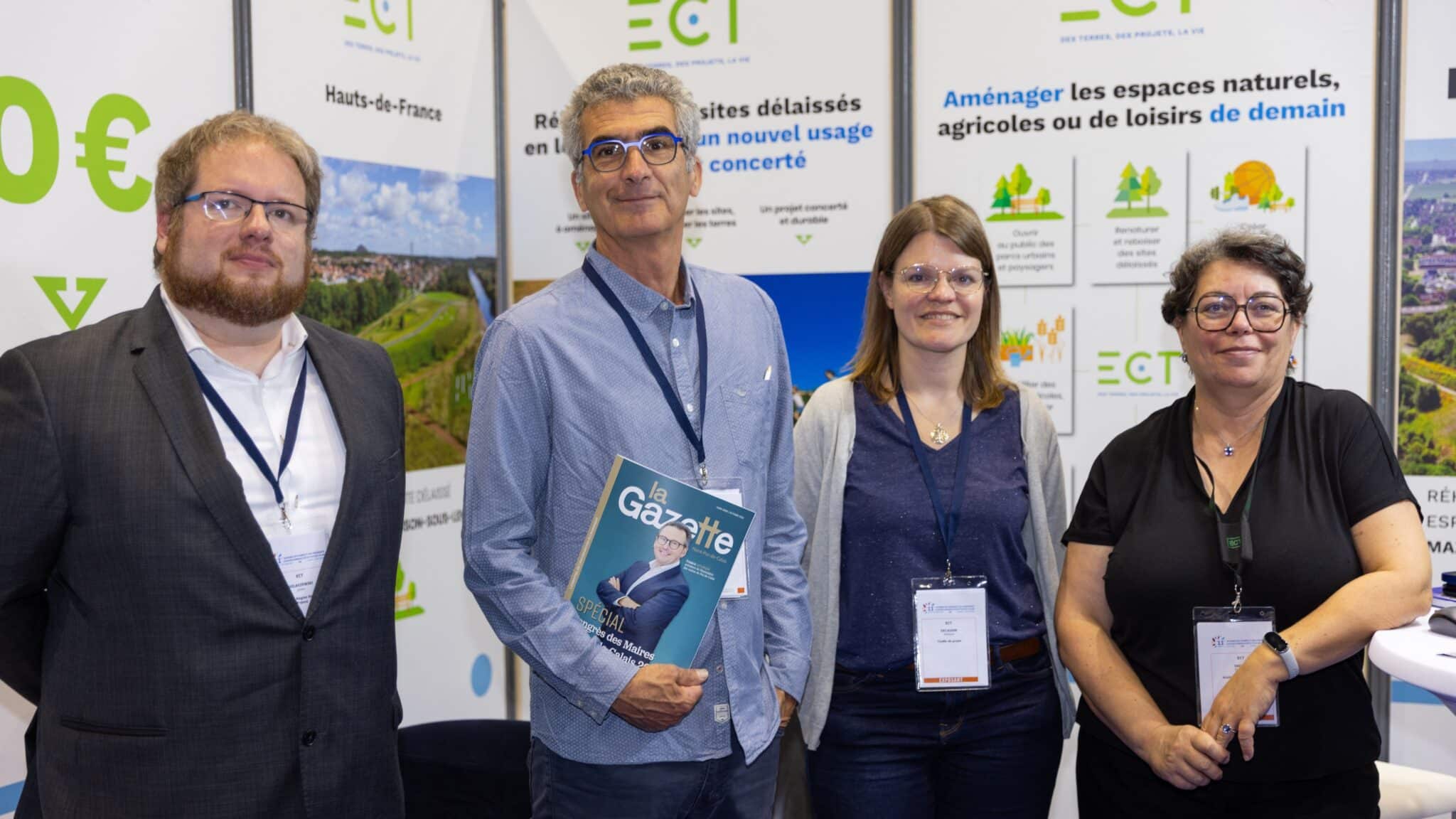
The ribbon was cut by Sandra Guthleben, subprefect of Lens; Laurent Poissant, mayor of Mazingarbe; Michel Marchyllie, executive director of Espaces naturels régionaux (ENRx); and Julien Golaszewski of ECT. The morning concluded with a toast to enjoy the view from the lookout point. This moment was shared with members of the Mazingarbe City Council, the Hauts-de-France Natural Areas Conservatory, the Mission Bassin Minier, the Chaine des Terrils, the Activ’Cités Neighborhood Authority, and the Noeux Environnement association.
The event provided an opportunity to trace the site’s history and present the initiatives undertaken to restore it to a purpose that benefits the local community.
At the foot of Sludge Pile 49, a site that had long been neglected
Before the project began, the land at the foot of the slag heap had been abandoned. Overrun with trash, it had also been taken over by an invasive exotic plant: giant hogweed. Yet it borders natural areas managed by the Conservatoire d’espaces naturels (CEN). The redevelopment project was therefore designed with a focus on ecology, landscaping, education, and improving the quality of life.
Its goals:
- open the site to the public;
- plant a seed orchard;
- create an urban forest;
- maintain an agricultural area.
Construction Land, Materials, and Financing for Transformation
Inert soil from local construction sites serves as both the material and the source of funding for this project. This soil was first used to create the necessary contours and to cover the giant hogweed, which has now been eradicated. Mixed with compost, this soil then forms a fertile layer conducive to the growth of young plants.
A seed orchard supporting the “Local Produce” sector
The seed orchard has been established on the plateau, on the site of the former coal mine settling ponds. Its goal: to boost the production of native shrubs with guaranteed regional origin. Industry stakeholders—nursery operators and associations involved in the “Végétal local” brand—can thus harvest seeds from selected mother plants in a single location.
The orchard contains 1,250 plants of 8 locally native species. Developed in collaboration with the French Office for Biodiversity (OFB), it was designed by ENRx, which selected the species, plants, and their places of origin based on the site’s soil conditions and local seed needs. The Noeux-Environnement association then carried out all the planting, both in the orchard and the forest.
A forest to protect the authenticity of seeds
A dense and diverse 1.1-hectare forest will surround the orchard. It will act as a pollen barrier by blocking pollen from outside, thereby ensuring the genetic authenticity of the seeds produced. Pollinating insects will thus remain within the orchard. There, they will pollinate, one by one, plants originating from different regions of the Hauts-de-France, promoting genetic diversity.
A new pedestrian path between Vermelles and Mazingarbe
The site is also open to local residents. A walking trail now connects Vermelles to Mazingarbe, allowing visitors to explore the surrounding countryside without having to use the national highway.
Key Figures
ha
project area
months
project implementation
trees planted
hectares
seed orchards
hectares
suburban forest
hectares
of farmland
We would like to thank all of our partners and elected officials for their presence and their commitment to our cause.