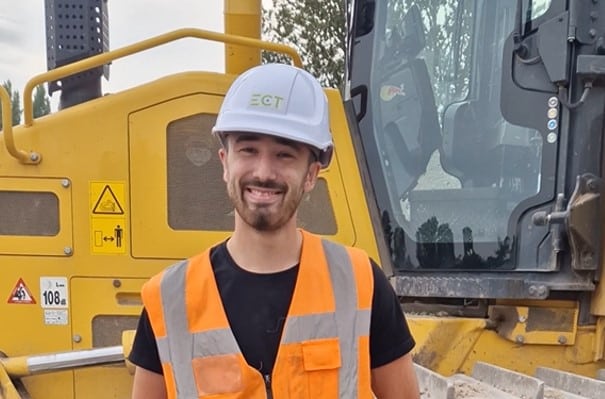
At our sites, a bulldozer operator shapes the terrain using soil from construction sites. At the controls of his machine, he pushes, spreads, and levels these materials to give them a second life: embankments, landscaped mounds, and future parks. In this way, this inert soil becomes the building block for new landscapes.
That’s how Baptiste learned his trade. He joined ECT as a work-study student after earning a CAP in heavy equipment operation, and he learned the ropes from his supervisor, Dimitri, and alongside his mentor, Belmiro. Upon completing his work-study program, he was hired on a permanent contract. After working on several projects in the Île-de-France region, he moved to the Hauts-de-France region, where he is in charge of the Harnes site (Pas-de-Calais). Today, he is shaping the project’s new terrain while operating a 3D GPS-guided bulldozer. He tells us about his journey and his enduring passion.
Become a heavy equipment operator through an apprenticeship
Do you enjoy your job as a bull rider?
Oh yes, yes, I love it! Otherwise, I wouldn’t have chosen it. It’s truly been a passion of mine since I was a kid. And I was lucky enough to be put on a bulldozer right away. I’ve always loved it.
What has your career path been like at ECT?
After completing several internships during my CAP program, I was hired by ECT on a work-study basis while pursuing my professional certification as a heavy equipment operator. I was trained by my mentor, Belmiro, who has a wealth of expertise. It’s thanks to him that I know how to operate a bulldozer today. I was then hired on a permanent contract. Dimitri, my former mentor during the work-study program, offered me numerous opportunities at ECT sites in the Île-de-France region; I worked in Annet-sur-Marne, Coubert, Vaujours, Villeparisis, Villeneuve-sous-Dammartin, and Chelles. Then he showed his trust in me by letting me work independently.
And do you operate other types of construction equipment as well?
At ECT, during my apprenticeship, I got to try my hand at everything. I have all the major CACES certifications—let’s say: excavators, loaders… all of them, except for the heavy equipment operator’s license!
And now, do you live in the Hauts-de-France region?
I moved to Lens when I started working in Auby and Harnes. I’m just ten minutes from here—it’s perfect!
My job: mapping the terrain down to the centimeter
What does the job of a bulldozer operator—or “bulliste”—on an ECT construction site entail?
First, I push and spread the soil unloaded by the trucks. Then there’s all the shaping and landscaping: I build embankments and sculpt the terrain to make the site look nice, following the project plan. I also inspect every delivery to make sure we don’t get just anything. I do a visual inspection and also feel the soil. Rejections are rare.
And in practical terms, what does rejected soil look like?
Soil is just soil… but it can contain unwanted materials, such as plastic. If the amount is minimal, we remove them and place them in the designated dumpster. If there’s too much, we refuse the load and have the soil reloaded onto the truck.
Is your bulldozer equipped with 3D GPS guidance?
Yes, absolutely! I have the embankments, slopes, elevation data, and everything else I need right in the machine—everything required to work accurately and move forward efficiently.
And does that make the job easier?
You have to get used to it, but honestly, it’s a huge help because I can plan ahead. You have to learn how to work with it—and honestly, I’m still learning! It’s a completely different experience from driving a bulldozer without guidance. When you only have the dashboard, you move the dirt by eye. With 3D, you can directly follow the project’s slopes, and I love that! You have to follow what the GPS indicates to do a good job. But it takes some getting used to: you have to be meticulous with the blade and be patient. It’s different… and I love it.
Should we take a more flexible approach?
Exactly—you have to take your time.
3D GPS Navigation: A New Tool for Bull Riding Competitors
Is your bulldozer equipped with 3D GPS guidance?
Yes, absolutely! The machine has all the data on embankments, slopes, elevation readings… everything I need to work accurately and move forward efficiently.
And does that make the job easier?
You have to get used to it, but honestly, it’s a huge help because I can plan ahead. You have to learn how to work with it—and honestly, I’m still learning! It’s a completely different experience from driving a bulldozer without guidance. When you only have the dashboard, you move the dirt by eye. With 3D, you can directly follow the project’s slopes, and I love that! You have to follow what the GPS indicates to do a good job. But it takes some getting used to: you have to be meticulous with the blade and be patient. It’s different… and I love it.
Should we take a more flexible approach?
Exactly—you have to take your time.


In Harnes, a new landscape is taking shape
We are in Harnes on a section of the site that is currently being redeveloped ?
Exactly. I start by leveling everything out and smoothing the entire surface, so I have a clean base and can shape it exactly as I want. Then we’ll tackle the higher areas, up to the level of the trees over there. The goal is to create something beautiful! Finally, we’ll build a gently sloping ramp to reach the top.
And what will be the highest point?
At the level of the small grove we’ve kept over there. That’s an eight-meter elevation gain.
Were the bases of these trees partially covered by the backfill?
Exactly. Before the construction, the trunks protruded further. But the trees had to be preserved.
And over there?
Ah, that side—that’s the most interesting part!
What exactly does this backfilling involve?
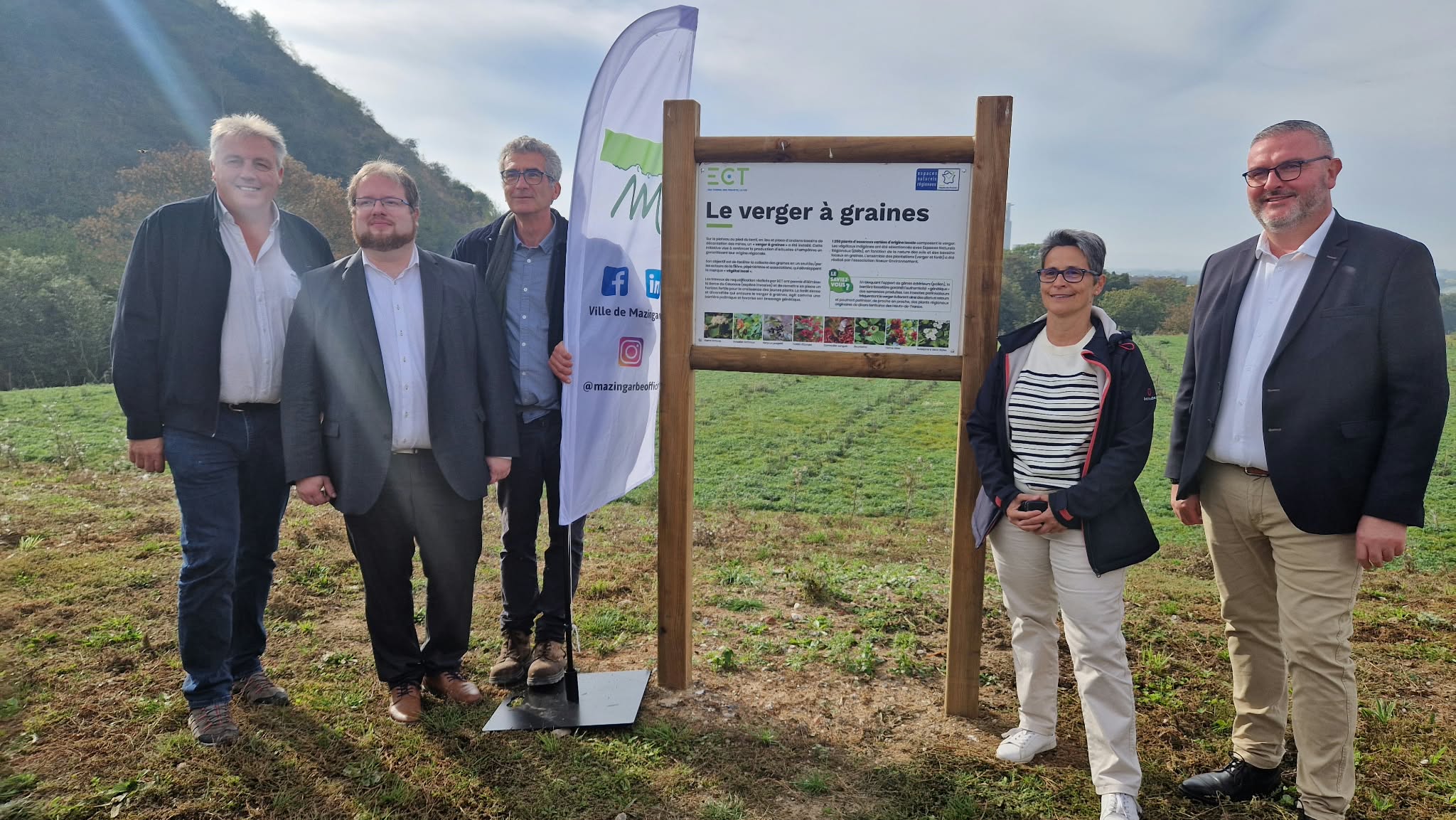
A significant portion of the project is now complete. A large area has been set aside for the future park. Here, the same principle applies: we’ve preserved the poplar trees and backfilled the area all around them. And near the large tree, a lookout platform will allow visitors to climb up and enjoy a beautiful view of the entire site.
How many people are on staff to run the site?
There are two or three of us here. I’m on the bulldozer. My coworker Nico sometimes comes by to lend a hand with the sweeper to keep the roads clean. And Max works at the reception desk, where he logs and checks every truck as it enters.
Winter: A Challenging Season for Drivers
Winter is approaching. How does this change things on the road?
We already know this: we’ll be receiving soil that’s harder to work with. Due to the weather, the soil will be wetter and heavier, and the bulldozer will have a harder time climbing. That’s normal—it’s just the season. But aside from this lack of traction, working conditions won’t change much. We’ll just have to be more careful on the slopes.
That pile of rubble is impressive!
It’ll come in really handy this winter for stabilizing the truck ruts. It’s actually a little too small for my taste! But it’s very clean, and I’m happy with it.