Icon Pin

Carrières-sur-Seine (78)

- Yvelines (78)

GPS coordinates :

48.915089, 2.162452

Securing a hazardous site and revitalizing a vegetable farm

Types of layout

Agricultural vocation

Picto, icone, remblaiement

Backfilling and securing quarries

Icon Enjeux

Issues :

Farm rehabilitation

Securing the site

Icon Etat d'avancement

Status:

In project

Project presentation

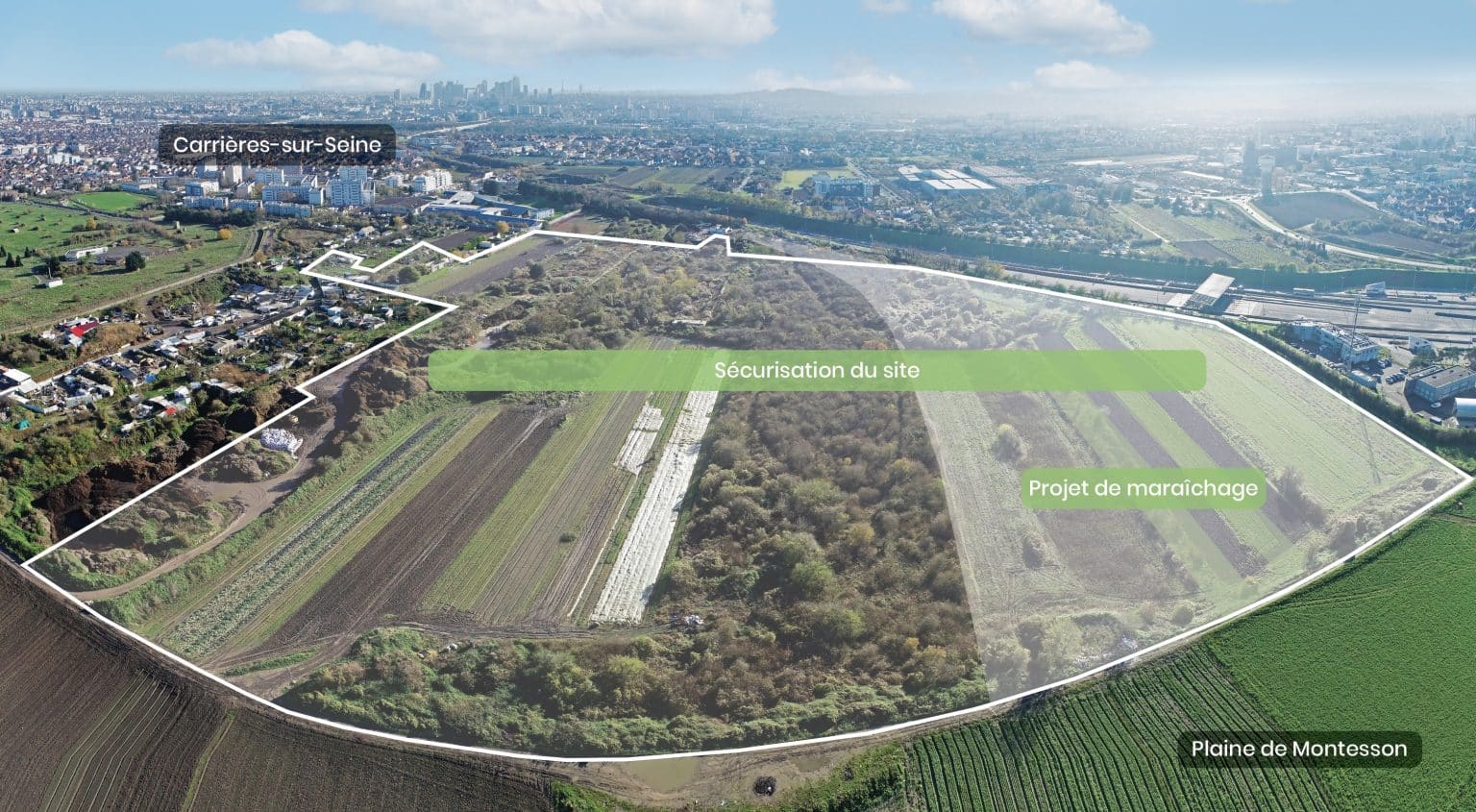
In partnership with the Saint-Germain-Boucles-de-Seine Urban Community and Grand Paris Aménagement, the City of Carrières-sur-Seine has embarked on an ambitious 84-hectare ZAC project. Located near the Montesson market garden area, this sector—which sits on former, unfilled limestone quarries—poses serious and proven hazards. Ensuring its safety is a complex priority for the City and the public authorities involved, both in terms of implementation and financing.

The collaborative project, led and implemented by ECT, provides a solution to the funding constraints involved in securing the quarries and rehabilitating part of the site for vegetable farming. By reusing inert soil from local construction and public works projects, the project makes it possible to carry out and finance the following at no cost to the local government or public finances :

  • Securing 16.5 ha of hazardous land.
  • Restoring 2.4 ha of agricultural land and 2.5 ha dedicated to biodiversity

Key figures

Phase 1

  • Securing by backfilling
  • 17 months of work
  • 440,600 m³ of reclaimed inert soil

Phase 2

  • Creation of a new market garden plateau
  • 185,400 m³ of reclaimed inert soil
1

hectares

secure underground quarries

1

hectares

requalified for market gardening

1

hectares

ecological restoration

1

trees and shrubs planted

Partners

Logo-Saint-Germain-Boucles-de-Seine
Grand Paris Aménagement-logo
logo - Carrieres sur Seine

Project life

Plan d'aménagement - Zone de maraîchage

Revitalizing a vegetable-farming area

Following the securing of the quarries, the project calls for the creation of a vegetable-growing area on part of the site and the restoration of the area :

  • Landscape transformation ; improvement of the site’s agricultural and ecological quality.
  • Elevation and reshaping of degraded land ; containment of contaminated soil, using inert soil brought in from local construction sites.
  • Traceability and inspection of the inert soil brought to the site.
  • Removal of encampments and demolition of temporary structures.
  • Disposal of illegally dumped surface waste
    through appropriate and approved channels (estimated cost : 495 K€)

These operations will create a fertile substrate produced on-site, suitable for market gardening and for resuming agricultural activity on remediated soils.

The project will include the creation of wetlands and the development of vegetated slopes with diverse plantings (groves, shrubs, and sainfoin grass). These features will help structure the landscape while promoting biodiversity by creating habitats conducive to birds, pollinators, and small wildlife.

Securing the basement

ECT is in charge of filling in the former quarries.

  • Securing the site and eliminating the risk of collapse, both above and below ground, by filling in 75% of the underground galleries .
  • Traceability and quality control of inert soil from local construction sites , used for backfilling.
  • Evacuation of litter from galleries to appropriate, approved facilities (estimate = 534 k€)
The use of traced and controlled inert soil from local construction sites will ensure the long-term security of the subsoil and surface land. As well as financing operations.

Further information

Environmental and social quality of ECT development projects

Financing and project development

Land traceability, a major challenge

See our examples of achievements

Pour recevoir
les dernières actualités d'ECT