
EEE: a global phenomenon, a local challenge for companies
Invasive alien species (IAS) are a recognized threat to natural environments. They represent the 4th factor in biodiversity loss worldwide. Their presence causes exorbitant agricultural, piscicultural, ecological and sanitary damage. In March 2021, CNRS researchers published a summary of the economic costs generated by the presence of IAS worldwide. Between 1870 and 2017, the loss amounted to US$1,288 billion.
For ECT, this global challenge becomes a local struggle. The initial neglect of most of the sites where we work encourages the presence and even the proliferation of IAS. In the context of our business, the development of the site and the restoration of its natural environments require us to make the fight against IAS a priority in our action to protect biodiversity.
Focusing our action
ECT is a player in the field: taking action. This has led the project teams – design, green spaces and operations – to innovate and transform their practices.
Because of their frequency on the sites of our development projects, ECT has defined three priority EEE targets:
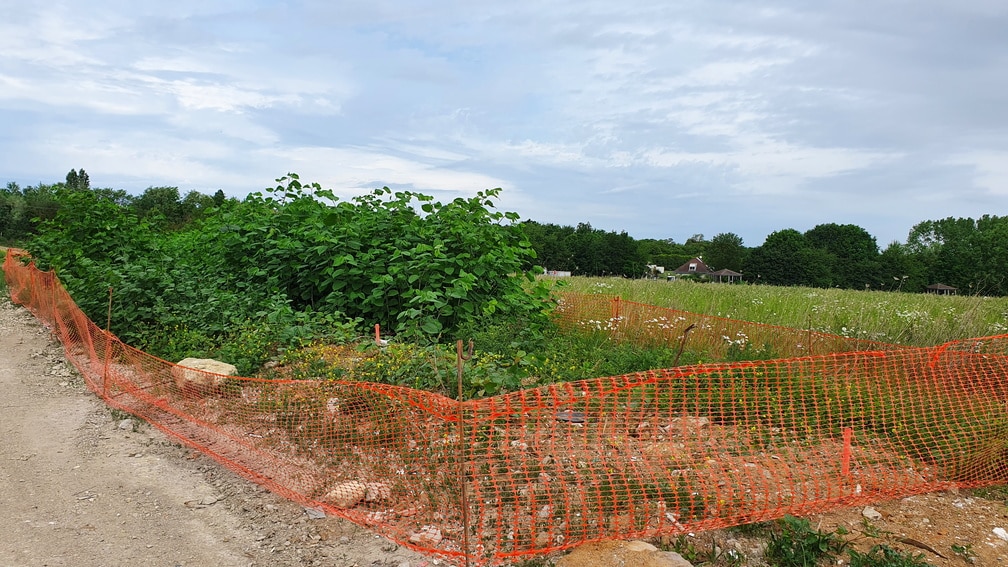
- Asian knotweed, Reynoutria japonica and Reynoutria sachalinensis
- Spanish Sainfoin, Galega officinalis
- Butterfly tree, Buddleja davidii
5 steps to action
We are implementing a 5-action control plan for these species and all IAS:
- Identify IAS present on site: map their locations and mark out areas to be treated with protective netting.
- Define the control strategy: depending on the species identified, the context of the site, its relief, the existing vegetation and the future use of the development.
- Neutralize their installation by uprooting: flush-cutting and bagging, terracing and placing in deep crates.
- Contain plants that can’t be removed: favourcompetition, especially for light. Plant fast-growing local species on certain slopes, such as black alder and common hazel. Also encourage the development of brambles. Finally, seed open spaces to prevent new germination.
- Monitor the arrival of IAS: train in-house teams, green spaces and operations teams, who are present on site every day.
Innovations, exchanges and feedback
These actions are directly in line with the National Plan to combat invasive species, implemented by the French Office for Biodiversity. They are the subject of regular internal feedback. These exchanges involve ecologists, local authorities and other stakeholders in our projects. They are also part of our partnership with Humanité et Biodiversité.
Example: Giant Hogweed in Mazingarbe
Giant hogweed (Heracleum mantegazzianum) is a large, invasive exotic species that rapidly colonizes open, damp environments. It competes strongly with local vegetation and can present a health risk by causing severe skin burns in the event of contact with its sap.
On the ECT site in Mazingarbemanagement operations have been carried out to remove this species and limit its spread:
- Removal of existing plants
- Covering with inert soil to limit regrowth
- Regular monitoring to detect and eliminate new growth
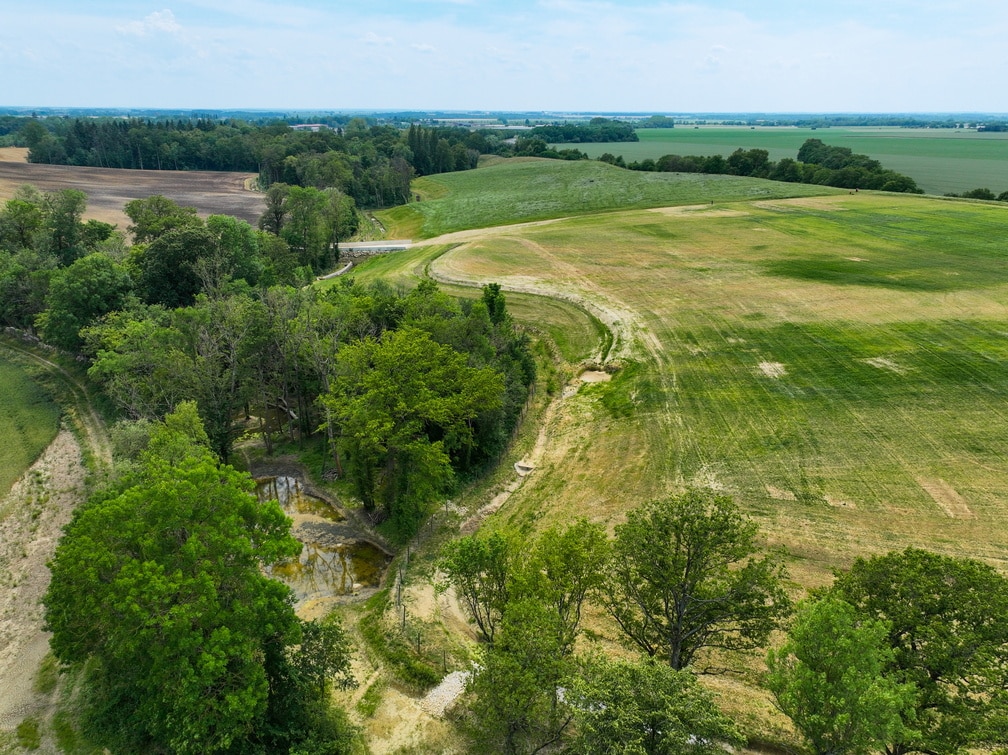
Today, in partnership with the Conservatoire d’espaces naturels des Hauts-de-France and Espaces Naturels Régionaux (ENRx), the rehabilitation of the site is complete: a seed orchard protected by a forest area was planted this winter.