
Protecting bees can’t be as simple as installing beehives for honey production (hives that most often house “Italian” or hybrid “buckfast” bees) on the roof of an administrative building in the heart of an urban environment, or placing an insect hotel in the middle of a well-mown green space.
The priority is to preserve wild species and their natural habitats.
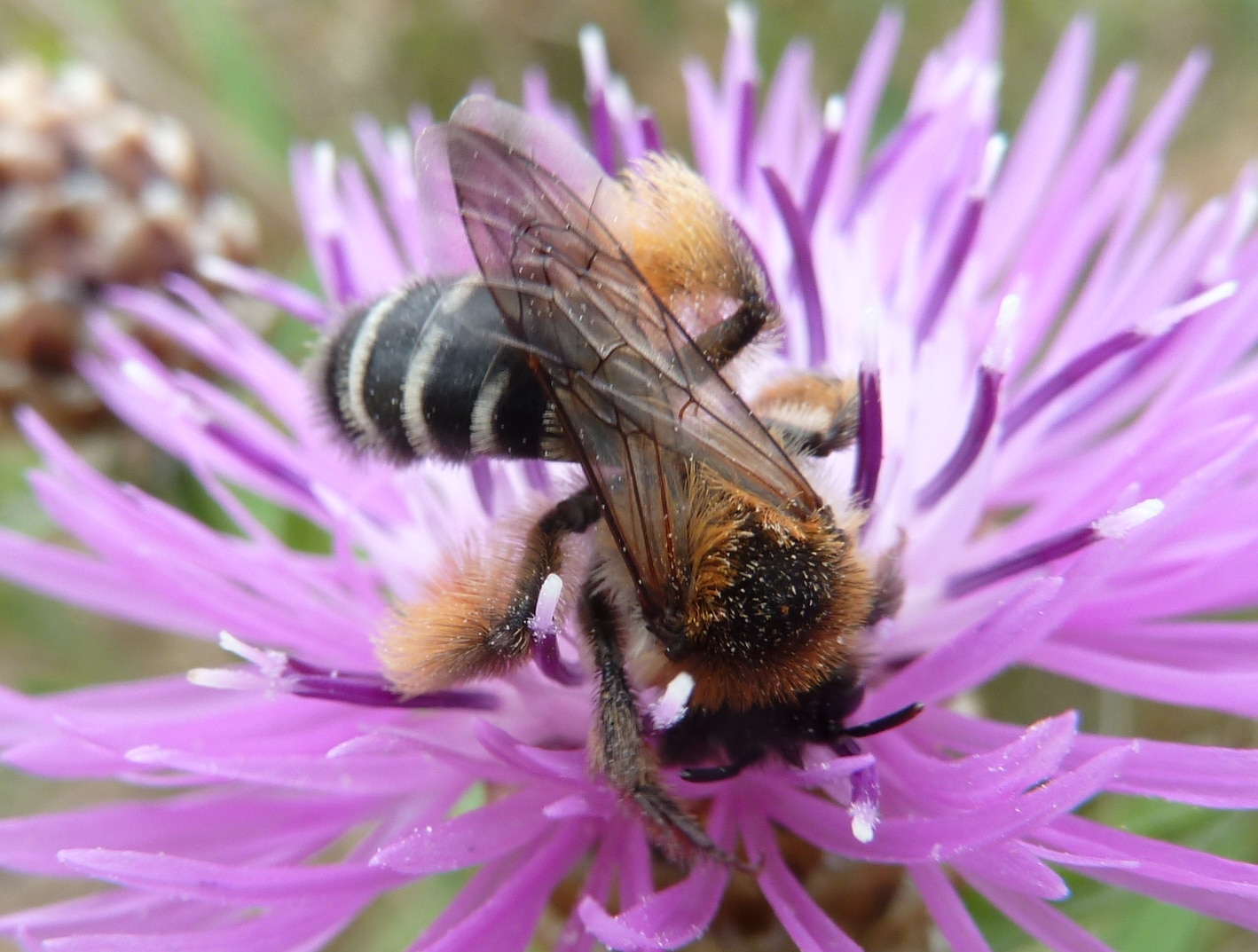
960 species of bees, 80% of which nest in the ground.
As we know, bees play a crucial role in the reproduction of entomophilous flowering plants. They also help produce fruit and vegetables. Above all, together with other pollinators such as hoverflies and butterflies, bees ensure the reproduction of wild plants. Thanks to this reproduction, wild flora is able to maintain itself, shuffle its genes, constantly adapt to changing living conditions and environments… in short, it evolves.
Protecting and promoting bees only makes sense if we include all bee species: bumblebees, halictes, megachiles, anthidia… In particular, specialist species, which pollinate only a narrow range of plants and are often among the most threatened.
Multiplying favorable actions in the field
Collectively, we must work to restore their natural habitats: by changing management methods, creating and preserving environments suited to their reproduction and strengthening their food resources.

That’s why the old racks from a waste disposal site have been recycled as part of the urban forest project on the Van Pelt site (Lens – 62)carried out by ECT at the request of EPF Hauts-de-France and local authorities. Our teams then filled them with sand of different granulometries to encourage the reproduction of terricolous and sand-loving bees. They also restored the dry meadows located nearby, by export mowing.
With this in mind, ECT almost systematically installs woodland, orchards, hedges and rural forest edges. Our teams also sow flower meadows and ground cover with clover, birdsfoot trefoil, etc. when carrying out our projects.