

The climatic and ecological transition of territories cannot be summed up in principles: it must be built in concrete terms, through development projects capable of transforming environmental constraints into opportunities. Through its actions, ECT works on the ground to rehabilitate wasteland and support local authorities in creating more sustainable, resilient and useful spaces.
The climate and ecological transition cannot be decreed. It has to be built on the ground, project by project, through development choices capable of responding to climate requirements, biodiversity issues and new uses for the sites to be rehabilitated.
Transforming derelict and fallow land into landscaped areas contributes to this transition. ECT sees each of its projects as a concrete lever for transforming unused sites for the benefit of local communities, thus creating the natural, agricultural or recreational spaces of tomorrow, while strengthening local resilience.
In partnership with local authorities, be an operational player in the transition of territories
Local authorities and developers are faced with complex requirements:
- Reducing carbon footprint
- Adapting to the effects of climate change
- Preserving resources and life
- While meeting economic and social needs
ECT’s redevelopment projects fit precisely into this equation. Our projects give a new use to derelict and abandoned sites. They directly implement the principles of a circular economy for excavated soil, which ensures that the project is financed and free of charge for the community.
In this way, we act as an operational link in local transition strategies, with concrete implementation on the ground.
Designing useful, sustainable and multifunctional facilities
Projects are designed in partnership with local authorities by ECT’s developers, ecologists and landscape architects, in association with external consultancies. They are based on eco-design principles:
- Multifunctionality of projects: taking into account societal (new uses) and environmental issues
- Use of natural water dynamics
- Diversity of restored natural environments
- Anticipating long-term management constraints
The aim is to create robust, low-impact developments that are useful to the region over the long term.
Supporting the climate and ecological transition in concrete terms
Regional transition requires responsible, measurable and reproducible development choices. The way we partner with local authorities, we choose to act locally on global impacts, to transform environmental constraints into levers of resilience, and to design projects that sustainably serve local communities and their inhabitants.
Mitigating climate change through sober, circular development
The first contribution to the climate transition is the effective reduction of greenhouse gas emissions at local level.
ECT projects enable :
- Limiting the transportation of excavated soil thanks to optimized territorial coverage. In 2024, this proximity enabled 43% of GHG emissions to be avoided.
- To reuse excavated soil locally as a raw material for our projects, significantly reducing long-distance flows and associated emissions. Excavated soil brought to our projects comes from local sites
- Sustainable carbon sequestration through massive planting of vegetation
On a regional scale, this means fewer trucks, lower emissions, and greater territorial and local coherence.
Adapting territories to the effects of climate change
Climate transition also means preparing our regions for more frequent episodes of torrential rain and heatwaves, and longer periods of drought.
As a result, our undeveloped facilities take these issues into account right from the design stage:
- Permeable soils and optimized infiltration to manage rainwater and limit flood risks
- Optimized design of perimeter ditches so that they become functional wetlands playing a hydraulic and ecological role
- Woodlands, meadows and plant continuities to create islands of coolness
The result: 95% permeable, functional soils that contribute to the climate resilience of the region.
Restoring biodiversity as a territorial infrastructure
Biodiversity is not an aesthetic “plus”. In fact, it’s a living infrastructureessential to the balance of our regions.
Our projects aim to achieve a positive biodiversity balance by integrating :
- Renaturation of diversified, locally adapted environments
- Restoring and creating wetlands
- Strengthening green and blue networks
- Protecting species and taking pollinators into account
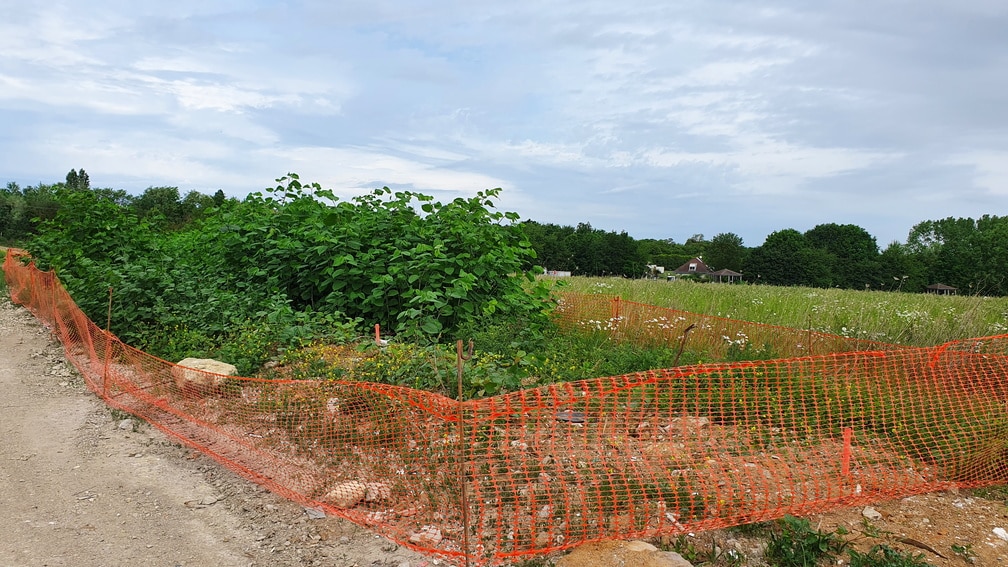
During the works, specific devices are installed (shelters, hibernaculums, micro-habitats) and plans to combat invasive exotic species are also deployed, with the aim of reducing the areas concerned by 80%.
Each year, between 10,000 and 50,000 trees are planted using local species adapted to future climatic conditions. Whenever possible, we work directly with the label Local Vegetable.
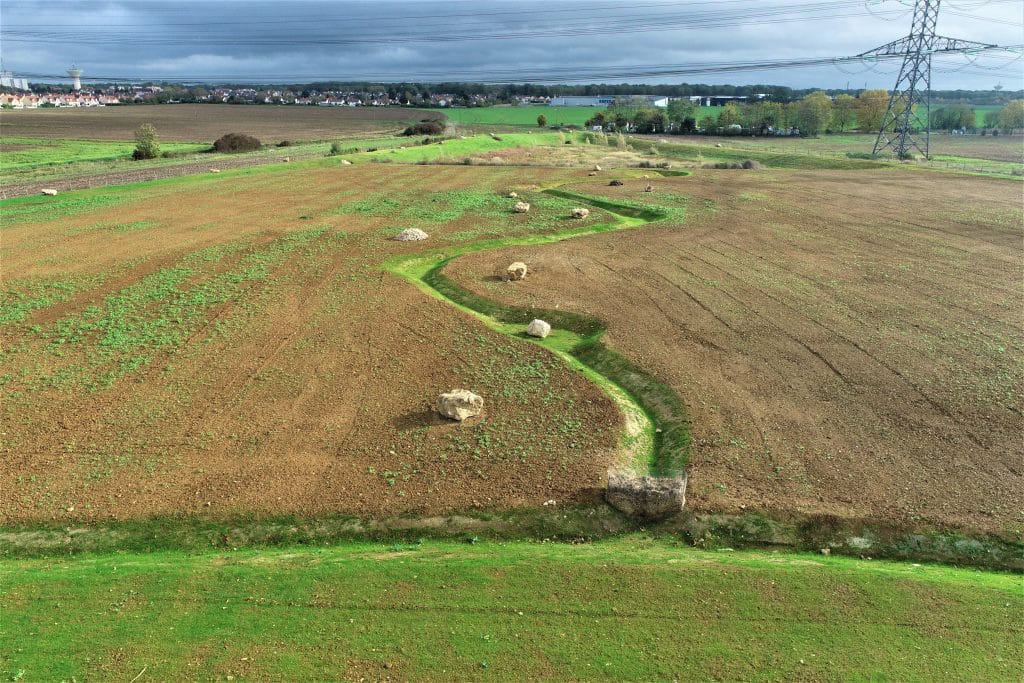
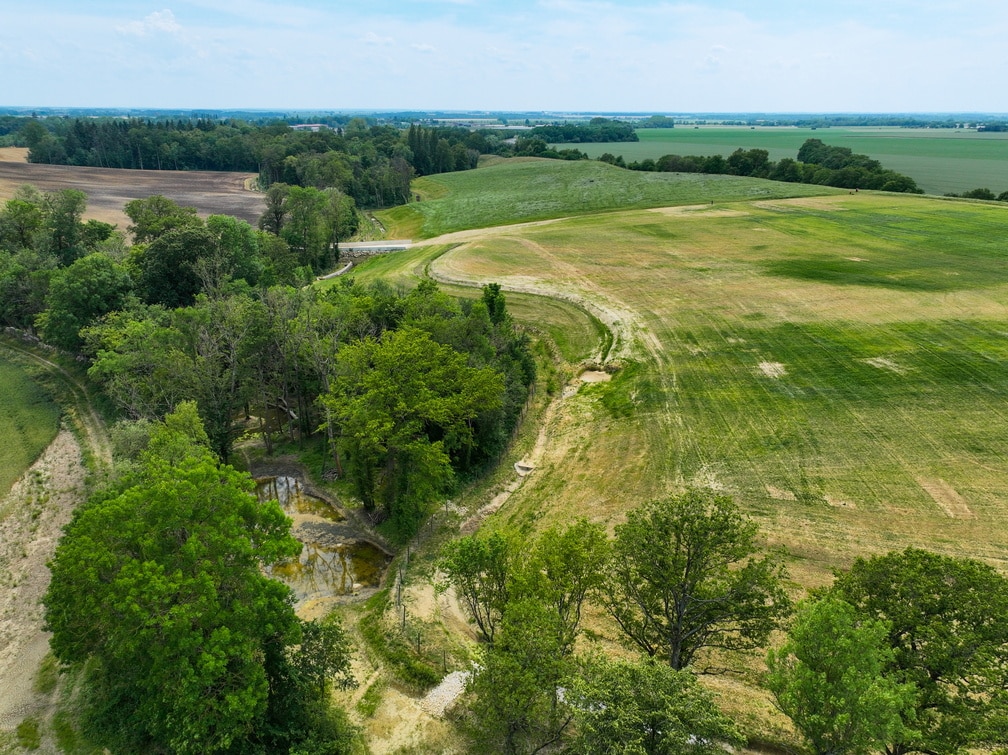
Creation of a wetland during agricultural agricultural rehabilitation in Roissy-en-Brie (77)A project that reconciles hydraulic, ecological and agricultural issues for the benefit of the region.
Soil, the foundation of the ecological transition
A resilient region relies on living, functional soil.
Our commitments:
- 100% traceability of inert soil received on our projects
- Erosion control by adapting the shape and slopes of the project based on a hydrogeological study of the site.
- Reuse of high-quality soils or creation of fertile horizons suited to future uses of the site
Fertile substrates: a concrete response to land and material sobriety
To limit the use of topsoil, a resource to be preserved, ECT is developing 100% recycled fertile substrates made from inert soil from urban construction sites and green waste compost.
These technosols avoid the need to import massive quantities of topsoil, and can therefore be adapted to the ecological requirements of recreating specific ecological environments (calcareous grasslands, mesophilic meadows, woodlands). These fertile substrates are manufactured on site, further reinforcing the circularity of excavated soil.

17 hectares of technosol produced in situ to green the future Jacques Chirac park in Chelles (77)